Markham Flooring Professionals
Secure top-quality concrete flooring in Markham that's designed for performance and compliance. Our service includes calibrated mix designs, verified slump/air/temperature and moisture/pH/RH testing for reliable hardening and attachment. We specialize in abrasive blasting/mechanical grinding to ICRI CSP, fracture/connection maintenance, and quick-drying base coats. Opt for honed concrete surfaces, resin-based/advanced coating solutions, or pigmented/enhanced appearances with ultraviolet-resistant coatings and verified flatness/levelness and mil thickness. We validate qualifications, assurances, and project duration to minimize hazards, expenditure, and operational impacts-then, explore how industry-tailored solutions match your needs.
Key Takeaways
- Expert concrete flooring services in Markham: focusing on precise mix formulation, structural reinforcement, joint placement, and curing processes aligned to construction regulations for consistent durability and performance.
- Certified contractors with WSIB and liability coverage, delivering thorough written project outlines, quality assurance testing, guarantees meeting ASTM/CSA requirements, and reliable project timelines.
- Surface prep and moisture control: RH/pH testing, concrete surface profile, crack and joint restoration, moisture barriers, and compatible primers for warranty-compliant installs.
- When it comes to polished, stained, or dyed surfaces, we provide professional services encompassing advanced grinding methods, lithium densification, ultraviolet-resistant sealants, slip resistance applications, and sample demonstrations to verify desired appearance.
- Our epoxy/polyaspartic systems feature exact mil thickness, vapor-blocking primers, non-slip aggregates, and verified FF/FL measurements for creating resilient, low-maintenance flooring systems.
Why Professional Concrete Flooring Matters in Markham
While concrete may appear simple, expert implementation in Markham directly impacts structural performance, surface flatness, moisture regulation, and overall lifecycle costs. You require a experienced contractor who expertly tailors mix specifications to match slab thickness, reinforcement specifications, and substrate conditions, then validates slump testing, air content levels, and temperature conditions for reliable curing. Professionals plan for local environmental factors-such as freezing and thawing, de-icing materials, and humidity conditions-by incorporating controlled air content, appropriate water-cement levels, and proper expansion joints.
Furthermore, you prevent compliance risks. Professional workers comprehend building codes, manage vapor barriers, reinforcements, and curing compounds, and track compaction and compressive strength tests. Precision finishing achieves FF/FL targets, decreasing trip hazards and racking issues. Proper drainage gradients and isolation joints prevent heaving and cracking. Simply put, professional methods safeguard structural reliability, get more info minimize callbacks, and extend service life.
Polished Concrete: Combining Beauty and Durability
Elevate functionality and appearance with polished concrete that delivers durable, clean, gleaming floors crafted for traffic and uptime. You get a hardwearing surface enhanced through advanced grinding, honing, and densification processes to maximize durability and reduce porosity. We then finish and seal to ensure durability and resistance.
Achieve the luster you require-from satin to micro mirror finish-while keeping slip resistance through aggregate exposure choices and controlled light reflectivity control. This enhances brightness efficiency, reduces maintenance, and optimizes cleaning cycles. Joints and surface imperfections are resolved before finishing to stop telegraphing and premature wear.
Count on predictable lifecycle expenses, quick return-to-service, and easy compliance with cleanliness and particulate standards. Concrete polishing provides consistent performance without surface treatments, peel, or separation issues.
Epoxy Coatings for Garages, Shops, and High-Traffic Areas
You'll need epoxy coatings that withstand mechanical wear, tire damage, chemical exposure, salt, and solvent contact without compromising or staining. To ensure that level of performance, you'll need to specify mechanical surface prep (via grinding or shot blasting), moisture and pH testing, and a compatible primer to secure optimal adhesion. Then you should apply the epoxy following manufacturer MVT guidelines, control application thickness and cure duration, and top it off with a UV-stable topcoat in areas exposed to traffic or sunlight.
Durability and Chemical Resistance
When operations require a floor that will perform under load, epoxy coatings provide high compressive strength, durability against wear, and established chemical tolerance for manufacturing areas, repair shops, and heavily-used passages. You gain resilience from secure chemical cross-linking within the polymer network, resulting in shock absorption, dimensional stability, and extended service life. Epoxy resists vehicle traffic, heavy equipment, and wheeled loads without gouging or raveling.
Additionally, you reduce degradation from different chemicals, including oils, fuels, and road salts. The dense film prevents penetration, limiting staining and delamination when exposure occurs. Heat cycles and moisture are controlled with reduced shifting, preserving bond integrity. Choose solids content and resin-hardener ratios to meet expected exposure. With the proper solution, you lower maintenance costs, lengthen maintenance periods, and keep operations online.
Surface Preparation and Application
Prior to epoxy application, proper substrate preparation determines the maximum performance. You must verify substrate moisture content, pH readings, and pull-off strength, then clear away surface contaminants and weak cement paste. Execute surface preparation by means of diamond grinding or shot blasting to achieve the specified CSP, maintaining clean, receptive pores. Address surface defects with joint filling compounds, and pay special attention to edge areas.
Start by controlling porosity by applying quick-drying primers that tolerate residual moisture and accelerate recoat windows. Broadcast to rejection where slip resistance or depth is required, then distribute the body coat using a roller or squeegee at the target thickness, keeping wet edge consistency and full coverage. Regulate ambient and substrate temperatures, dew point, and air circulation. Conclude with a UV-resistant topcoat to guard against wear, chemical exposure, and allow for simple maintenance in garage environments and busy spaces.
Custom Concrete Staining and Dyeing for Unique Colors and Patterns
You can specify an exact color palette by applying acid-based stains for varied effects or water‑based dyes for crisp, uniform hues that align with your branding. We'll engineer pattern and texture effects-precise cuts, stenciled designs, layered effects, and controlled color blending-to produce stone, tile, or graphic looks with reliable reproduction. To secure color and performance, we'll determine the right sealer (penetrating, polyurethane, or polyaspartic), then create a maintenance plan with neutral pH cleaners and periodic reseals based on traffic.
Color Scheme Choices
Color drives performance in concrete design, and stained and dyed applications yield precise, repeatable results. You pick from standardized color palettes that align with project requirements or brand guidelines, then we confirm with on-site samples under your actual lighting. Acid stains produce varied organic shades-terra cotta, brown, gray-ideal for retail, civic, and hospitality venues seeking gentle illumination. Solvent and water-based dyes broaden into saturated Jewel tones-peridot, tanzanite, rhodolite-supporting bold wayfinding and premium merchandising.
We evaluate surface conditions like porosity, moisture content, and cement makeup to forecast penetration, then establish dilution, dwell time, and application sequence for evenness. Ultraviolet-protective coatings secure pigmentation, while gloss levels tune reflectance targets. You get color continuity across phases with documented mix ratios and production monitoring, guaranteeing uniform, lasting performance.
Texture and Pattern Effects
With carefully selected tones established, pattern and texture serve as performance elements that direct movement, reduce glare, and define zones. You can specify colored or stained concrete as the foundation, then layer strategic patterns to achieve measurable results. Linear scoring, precision-cut edges, and laser-cut designs establish navigation paths and merchandise areas without additional fixtures. Textured surfaces deliver non-slip surface texture while replicating decorative elements or company symbols. Reactive stains create unique variations; aqueous colorants achieve tight, reproducible shades for precise motifs.
We carefully map traffic flow, access points, and retail areas so textures guide movement and rest areas. Non-reflective surfaces decrease brightness from LED systems, preventing camera flare and optimizing optical comfort. Edge detailing and inlays complement identity requirements, supporting durability, safety, and efficient installation.
Sealing and Maintenance Tips
Establish lasting performance by matching the sealer with the coloring method, exposure conditions, and traffic classification. Apply penetrating sealers for permeable, UV-resistant stained floors; choose high-solids urethanes or polyaspartics where abrasion and chemical exposure are expected. Confirm VOC requirements and slip prevention values. Prep carefully: verify neutral pH following staining, perform 200-400 grit buffing if required, and install within the manufacturer's specified recoat timeframe.
Set up periodic inspections to assess finish quality, coating durability, and scratch patterns. Measure wear areas at doors, cash wraps, and forklift aisles; plan selective recoat prior to color loss. Put in place a consistent spill cleanup procedure: contain, absorb, treat, and clean - no acidic cleaners or undiluted degreasers. Utilize microfiber dust control, autoscrub with pH-neutral detergent, and implement sacrificial finish in high-traffic areas. Record maintenance data to improve lifecycle investment.
Essential Guidelines for Surface Preparation and Moisture Control
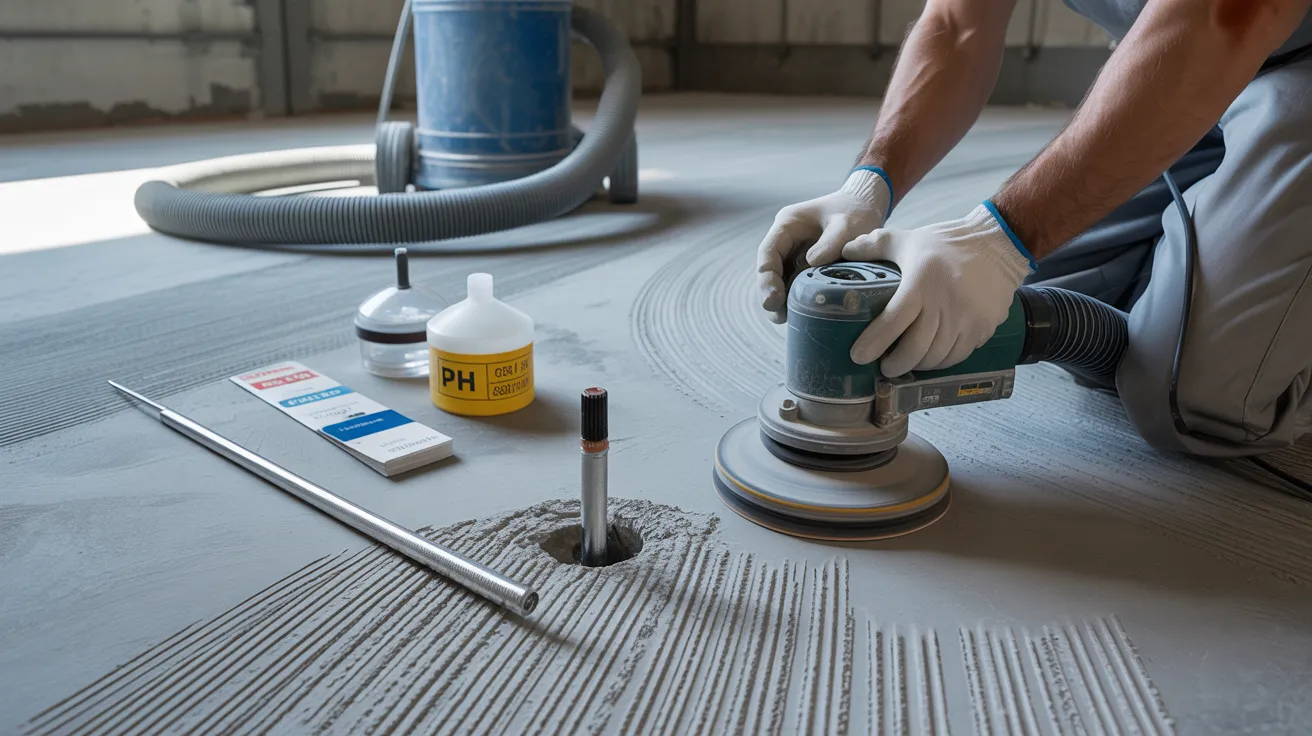
Prior to applying any coating or overlay, rigorous surface preparation and moisture control dictate performance and warranty viability. Initial steps include performance testing: ASTM F2170 RH probe analysis, ASTM F1869 calcium chloride testing, and pH measurements. Next, eliminate contaminants, then execute substrate profiling to the designated ICRI CSP, using mechanical preparation through shot blasting or diamond grinding. Fix cracks, spalls, and joints using appropriate repair products, and completely vacuum to achieve a dust-free surface prior to priming.
Resolve water-related challenges at the source. Verify vapor barriers beneath the slab exist and function; if barriers are non-existent or deteriorated, install surface moisture control solutions suitable for your slab's moisture levels. Handle structural cracks and seams using elastomeric materials to enable flexibility. Specify primers based on epoxy or urethane that work with current moisture conditions. Record moisture readings, prep techniques, and cure periods to ensure compliance with manufacturer warranties and achieve reliable outcomes.
Business, Industrial, and Home Applications
Validated prep and moisture control establish the basis for performance across segments, but implementation focus shifts by application. In commercial environments, you have to harmonize wear patterns, design elements, and long-term expenses. You choose eco-friendly materials for environmental certification, densifiers for wear protection, and coatings engineered for anti-slip properties without compromising cleanability. You additionally plan for temperature-related movement at storefronts and glass-enclosed courtyards.
For industrial environments, you need to focus on protection against impacts, chemical exposure, and forklift operations. You strategically design racking aisle joint configurations, calculate proper reinforcement, and implement coatings that handle thermal expansion from process heat. Noise reduction is essential in proximity to testing labs and QC departments.
In residential settings, we prioritize comfort and hassle-free care. We incorporate acoustic dampening materials, radiant-ready floor systems, and specialized sealants that offer non-slip properties while preserving a welcoming finish.
Picking the Perfect Contractor: Credentials, Warranty, and Timeline
When hiring a flooring contractor in Markham, examine expertise and track record with similar diligence you use for mix designs. Verify the contractor employs licensed installers, maintains WSIB and liability insurance, and holds manufacturer certifications for the specified system (polished, epoxy, urethane-cement, or overlays). Review project references with equivalent loads, exposure, and schedule demands.
Demand a comprehensive scope that includes: surface preparation, moisture control, strengthening, installation, finishing, and quality assurance testing. Secure a warranty that outlines coverage, exceptions, and resolution periods; link it to performance standards including compression resistance, floor profile (FF/FL), and surface coat measurement.
Evaluate project timeline reliability by analyzing: manpower allocation, equipment readiness, curing intervals, and fallback provisions for climate impacts and material shortages. Set up a well-defined issue resolution framework, emergency response contacts, and regular update schedule.
Financial, Maintenance, and Value Assessment
With these fundamental elements, align the budget towards long-term operational efficiency, rather than upfront costs. Assess setup costs combined with long-term cost considerations to account for slab thickness, reinforcement, joint configuration, curing processes, and coating systems. Determine coating options based on wear tolerance, chemical protection demands, and traction requirements to avoid premature failures.
Outline maintenance plans ahead of the pour. Determine cleaning chemistry, sealer application timing, and crack prevention strategies to maintain gloss, color, and flatness tolerances. Calculate costs for grinding/polishing maintenance, expansion joint updates, and humidity management where applicable.
Evaluate total cost of ownership: energy reflection (lighting cost savings), maintenance windows for service, and projected lifespan. Record warranty terms related to loads and environmental factors. Calculate resale impact by demonstrating compliant surfaces, reduced maintenance backlog, and portable warranty coverage. You'll decrease unforeseen spending and protect investment value.
Popular Questions
Do You Accommodate After-Hours and Weekend Implementation to Limit Impact on Operations?
Absolutely. You can schedule after-hours or weekend installation to reduce downtime. Our team manages overnight arrangements and send emergency personnel when necessary, while phasing work to ensure access and safety. Our team manages dust control, noise levels, and curing processes to fulfill operational constraints. We provide thorough planning, customized site arrangement, and quick deployment. You'll receive work progress notifications, quality verification, and detailed completion documentation, ensuring your facility reopens on time with clean, compliant, and lasting outcomes.
Is It Possible to Install Underfloor Heating Into Concrete Floor Installations?
Absolutely, you can integrate radiant floor heating with concrete flooring systems. Think of it as forging Excalibur: attention to detail is essential. You select hydronic systems for large spaces and energy efficiency, or electric mats for specific areas and quick heating. You align slab thickness, insulation, vapor barriers, and control joints to secure tubing/cables. You confirm load calculations, spacing, and manifold/electrical layouts, then initiate pressure and continuity tests, guaranteeing uniform heat, minimal thermal lag, and long-lasting performance.
Tell Me About Your Environmentally-Friendly and Low-VOC Product Selection?
You can select eco-friendly options using low-emission sealers, aqueous epoxies, and high-solids urethanes to lower environmental impact and installation time. Select blends with reclaimed materials, supplementary cementitious materials (coal ash, slag), and nearby materials to reduce embodied carbon. Choose lithium densification products with ultra-low VOC profiles. Specify polished concrete to eliminate topical coatings where practical. You'll obtain long-lasting, wear-resistant surfaces, conforming to LEED/WELL standards, without compromising cure times, material bonding, or long-term durability.
Do You Deal With Permits and Condominium Board Approvals in Markham?
We offer permit assistance and condo coordination in Markham. You won't struggle with red tape; we manage applications, submit drawings, and monitor approvals. We coordinate with property managers, security, and boards to coordinate bylaws, noise windows, elevator bookings, and load limits. We furnish insurance certificates, WSIB, site-specific safety plans, and engineer letters as required. You receive clear timelines, stakeholder updates, and documented compliance, guaranteeing your project proceeds as planned and prepared for inspections.
Can You Match Existing Concrete Finishes During Partial Renovations?
Absolutely, matching existing concrete finishes during partial renovations. Begin by conducting a thorough assessment, conducting mix design analysis, aggregate analysis, and finish calibration. Use color matching via dyes, pigments, or stains adjusted with test panels. Carry out texture replication through custom trowel patterns, abrasive blasting textures, or micro-topping stamps. Regulate cure rates and gloss with hardeners and protective finishes. Validate with side-by-side mockups under project lighting to guarantee seamless integration.
Final Thoughts
You want a floor that functions like clockwork-built to spec, clean, and long-lasting. With polished concrete, epoxy, and stains, you'll align aesthetics with load, traffic, and lifecycle. Thorough preparation and humidity management avoid future complications. Review qualifications, guarantees, and timelines to maximize returns while minimizing risk. When you choose proven Markham specialists, you'll guarantee a finish that resists abrasion, chemicals, and downtime while minimizing maintenance and total cost of ownership for years.